The Uncertainty Principle: Can you rely on your OpenVMS system five years from now?
Your OpenVMS system is stable today. But could you say what state it will be in five years from now? A look at the factors that quietly erode reliability over time, and the practical steps you can take now to reduce the uncertainty.
Old DEC-hand

In 1927, Werner Heisenberg formulated one of the strangest ideas in modern science. The Uncertainty Principle states that you cannot simultaneously know both the exact position and the exact momentum of a particle. The more precisely you pin down one, the less you can know about the other. It is not a limitation of the measuring equipment. It is a fundamental property of the universe: some things cannot be known at the same time.
That is quantum mechanics, and OpenVMS servers are reassuringly less mysterious than subatomic particles. But with a little poetic licence, the same principle describes something every long-standing OpenVMS site will recognise. There is a great deal about the future state of your systems that you cannot know today, however stable they look right now.
Think about it. Your system has run reliably for years. But what state will it be in five years from now? The people who originally configured it, the hardware quietly ageing in the rack, the workloads that have crept up year on year: each introduces a little more uncertainty. And like Heisenberg’s particle, the harder you try to rely on the system staying exactly as it is, the less certain that reliance becomes.
Every IT system depends on the same handful of elements
We are not talking about position and momentum here, of course, but about hardware and software. Any IT solution needs several elements to work properly, whether it is a Windows server running company payroll or an AI tool answering questions about your favourite football team. These tend to fall into four or five groups:
Computer hardware. A must-have.
Network access. Nearly all applications now rely on some kind of network connection.
Operating system. Of some sort. This enables your application to “talk” to the hardware.
The application. The software that actually performs the task, be it payroll or AI research.
Third-party software. A discretionary element, but when used, it helps the application run smoother and faster on the underlying infrastructure. There are many types: databases, queue managers, transaction managers, backup software and so on.
So where does the Uncertainty Principle come into it? It comes in when you don’t know the state of your IT systems in, say, five years. How many people today can predict what their OpenVMS environment will look like that far out? Uncertainty.
The risks grow as you rely on the system more
VSI made a similar point recently in a post advertising one of their webinars. It is worth quoting, because it frames the problem well:
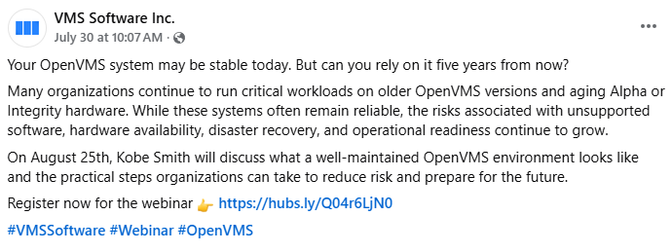
“Your OpenVMS system may be stable today. But can you rely on it five years from now? Many organizations continue to run critical workloads on older OpenVMS versions and aging Alpha or Integrity hardware. While these systems often remain reliable, the risks associated with unsupported software, hardware availability, disaster recovery, and operational readiness continue to grow.”
The phrase that matters there is “the risks continue to grow.” They grow precisely because companies become more reliant on their systems over time, not less. And I would add one more risk to that list: security.
For decades OpenVMS has been acknowledged as one of the most secure operating systems around. But that reputation only holds if the system is implemented and maintained correctly. It is worth remembering that weak passwords and poor practice sit behind a large share of data breaches across all platforms:
“Weak passwords cause 30% of global data breaches, and poor practices cause 81% of company breaches.” (Demandsage password statistics)
OpenVMS is not exempt from that. The good news is that most of the tools you need to harden a system are already in the operating system. The task is making sure they are actually being used.
Practical steps you can take now to reduce the uncertainty
Nobody can tell you exactly what your environment will look like in five years. But you can take steps today to make it more predictable and less exposed. Here are the key contributing factors and what can be done about each.
Weak passwords are an OpenVMS problem too
The folklore that OpenVMS is the most secure operating system is only valid if the system has been set up correctly. That breach statistic above applies to OpenVMS as much as anything else, so make sure you have a robust password and privileges regime in place. The tools to do it are in the operating system, so use them.
Growing workloads slow down systems that were sized years ago
Hopefully your company has grown over time, and its IT requirements have grown with it. Bread-and-butter applications like payroll, accounting, warehouse management and process control will have increased in volume.
Systems configured for “X” people or products now have to handle “Y,” which usually means things take longer to run. The obvious answer is to upgrade the hardware or software, but that often isn’t viable.
So what do you do instead? Look at the configuration. Could something be done better? Could you allocate more resources, change timings, or defragment the disks? There are usually many areas in an existing system where improvements can be made.
Older hardware and software may be worth moving on from
Following on from the point above, if upgrading is viable then it is an obvious way to improve things. Moving from Alpha or Integrity to x86 and the latest version of OpenVMS will probably give your system a boost, and hopefully reduce operating costs at the same time.
“Set it and forget it” stops working as the business changes
This has always been a quirk of OpenVMS: set it up once and let it run forever. That would be fine if nothing ever changed, but that is not the real world. As companies grow and new applications are added, a configuration that was once well judged is no longer suitable. It is worth getting someone to look at your configuration and bring it up to today’s standards.
Ageing hardware degrades quietly
Hardware does degrade over time. Bits (excuse the pun) get slower, either through fatigue or poor maintenance. Audit your hardware and see what you actually have. Is there a better option? Are the individual components running at optimum performance? It is worth checking.
Networks have grown up around systems that were built for local traffic
This is an interesting one. When OpenVMS systems first appeared, networking was local. Over the years, company networks have grown, driven largely by access to the outside world, and often at the expense of internal systems. Is your OpenVMS configured correctly to handle that traffic expansion, or is the network now overloading it?
Configuration mistakes can cost you for years
Last but not least. If a system was configured incorrectly in the first place, you will still be paying the price for that mistake. I remember configuring two VAX 750s to be clustered decades ago, but I didn’t do it properly. The two machines spent all their time trying to talk to each other and doing no actual work. That one was easy to spot and fix with some additional hardware, but some misconfigurations are subtle and require a bit more investigation to uncover.
Deal with today, and tomorrow takes care of itself
Let’s get back to the Uncertainty Principle. Heisenberg’s insight was that some things genuinely cannot be known in advance, and no amount of measurement changes that. The future of your OpenVMS environment is much the same: nobody can predict what the next five years will bring.
But unlike a subatomic particle, your systems will respond to attention. You cannot eliminate uncertainty entirely, but you can reduce it by ensuring everything runs at its best today. Do that now, and tomorrow has a much better chance of taking care of itself.
A Newcorp OpenVMS Health Check reviews the areas covered above, from security and configuration to hardware and network, and gives you a clear report on where your environment stands and what to prioritise.
More articles
View all
When “it’s just running slow” hides a much bigger problem
A sluggish OpenVMS system is easy to treat as a single fault. On a mature environment it's often the tip of something harder to pin down. A look at why performance problems resist the obvious fixes, and how a Health Check finds the real cause.
The Rdb Conundrum and Ways to Solve It
Oracle's decision to end Rdb support on OpenVMS X86 has been on the cards for years. With the Malmö Bootcamp 2026 bringing the conversation into the open, we look at the options available to Rdb customers who want to plan their next move.
Monitoring OpenVMS Servers with Modern Tools
OpenVMS has long been a cornerstone of mission-critical computing. But as the pool of skilled engineers shrinks, visibility into how these systems are performing has never been more important.
Comments are reviewed before they appear publicly.
Comments (0)
No comments yet. Be the first to add one.